A private mastermind in Las Vegas. A room of speakers, consultants, and advisors.
The organizer assigned me scalability as my topic and later confessed he let ChatGPT pick it.
Fair enough. I'll take it.
I've spent eight years doing technology diligence on 250-plus deals for private equity. Same question every time: will it scale?
Scalability is not the same thing as growth. Growth is more. Scale is more output without proportionally more input.
That distinction matters a lot when you're deciding what to do with AI.
Here's the framework I've used on every one of those deals, applied to a speaking business.
Four phases: Prove. Repeat. Scale. Sustain.
Investors care about the third one. The ones who lose money skip to it.
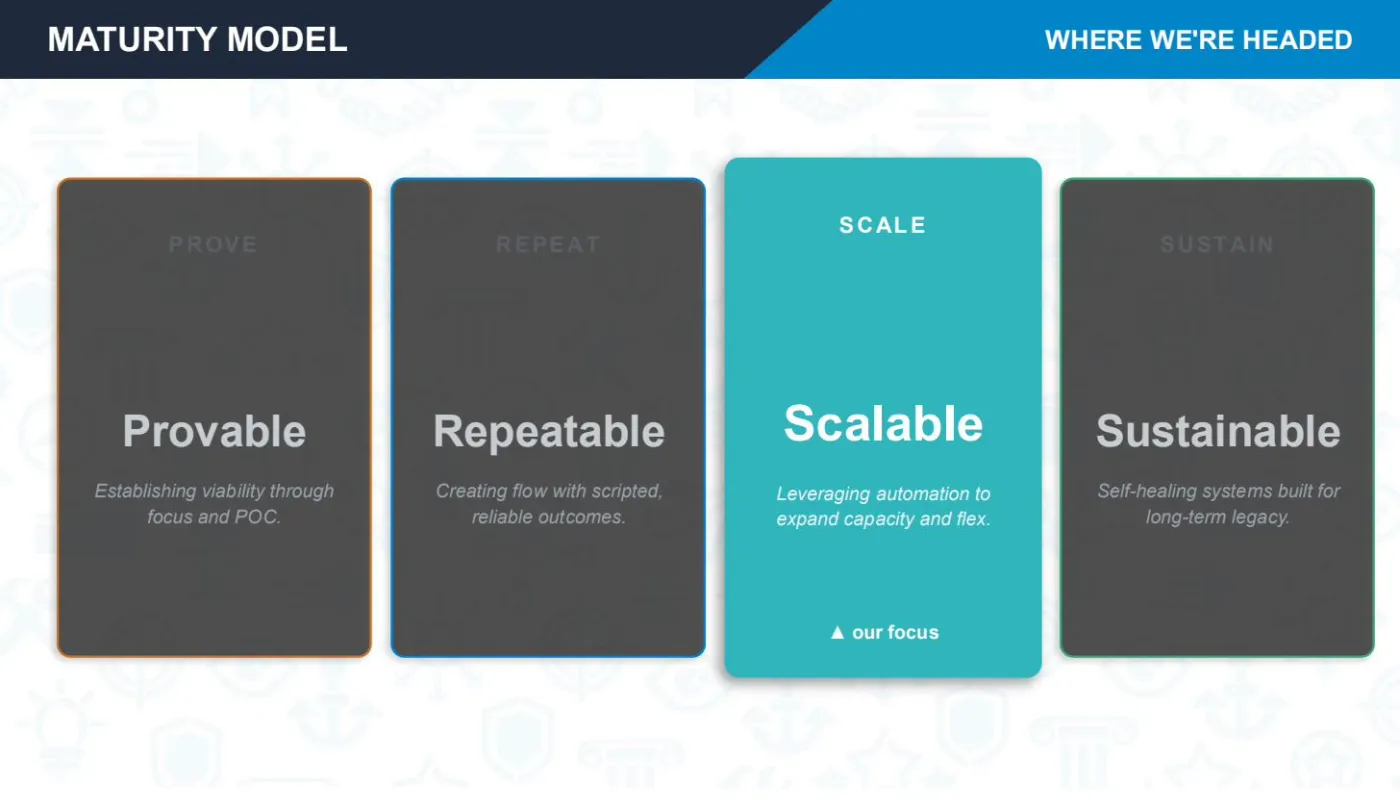
Before you can scale anything, it has to exist. That's Prove.
Before you can automate anything, it has to be consistent. That's Repeat.
You cannot scale what is not proven and repeatable. I say this to every engineering team I lead, and it applies directly to your speaking business: your follow-up sequence, your intake process, your book offer, your referral ask.
If it only works when you're personally running it, it is not ready to scale.
Scale on a shaky foundation is just faster chaos.
But this is where most AI advice for speakers goes wrong. "Automate everything."
The advice is half right. Here's the half that's missing.
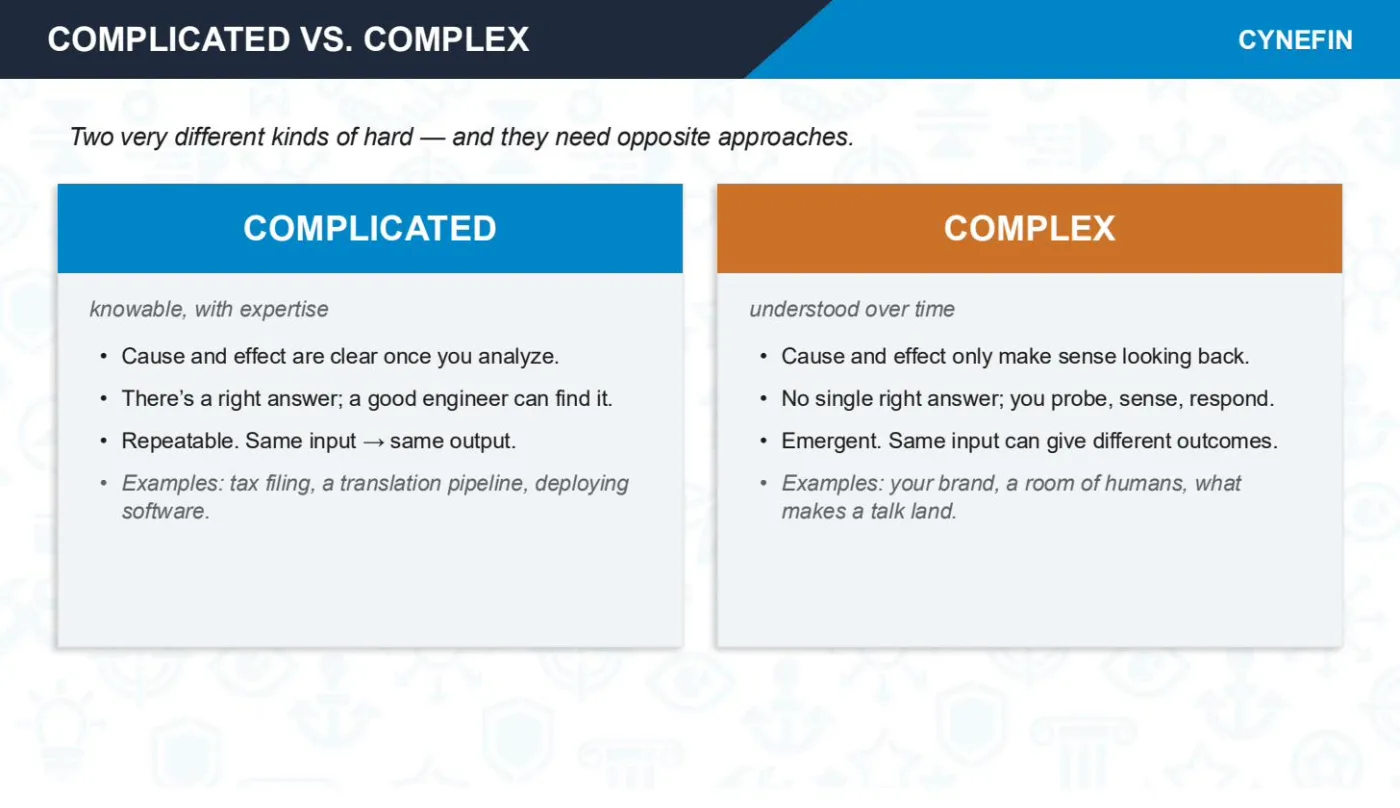
Researcher David Snowden built a framework called Cynefin. It draws a hard line between two kinds of problems that people treat as the same thing.
Complicated means cause and effect are knowable. There may be a lot of moving parts, but with enough analysis you can map the process and get a consistent result.
Tax filing. A follow-up email sequence. A translation pipeline. An intake form.
These are complicated. They are expert-solvable. You can flowchart them.
Complex is something different. Your brand. What makes a talk land in that particular room on that particular day with those particular people. The relationship with a client who just got bad news before your call.
These have no fixed process. The same inputs give different outputs. Cause and effect only make sense looking back.
No flowchart covers it.
AI is excellent at complicated. It is not reliable on complex.
That is not a deficiency. It is physics.
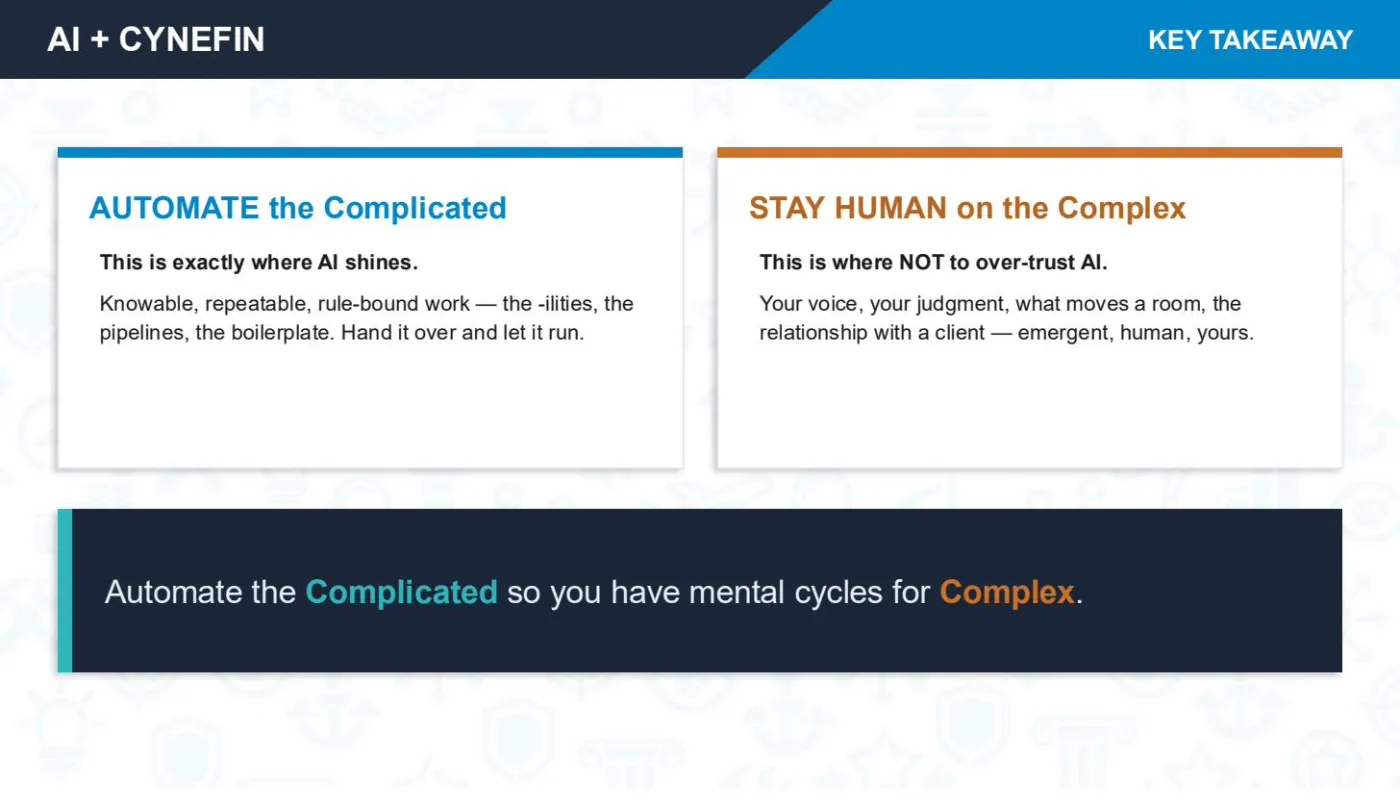
Automate the complicated so you have mental cycles for the complex.
Hand off the follow-up, the formatting, the boilerplate, the translation, the intake.
Keep the room, the relationship, the judgment call.
One person in that room had already done exactly this. He built a client-intake app in a few weeks using Google AI Studio.
No code background. No agency. Thirty dollars a month.
Clients answer questions, get a scoped report, see themselves in it. He owns it. It repeats.
That's the move: get the complicated parts off your plate so you can show up fully where the complex ones live.
Get the complicated off your plate. That is where you earn your fee.
Presented at the Cigar PEG Las Vegas Mastermind, MGM Las Vegas, May 28, 2026.